
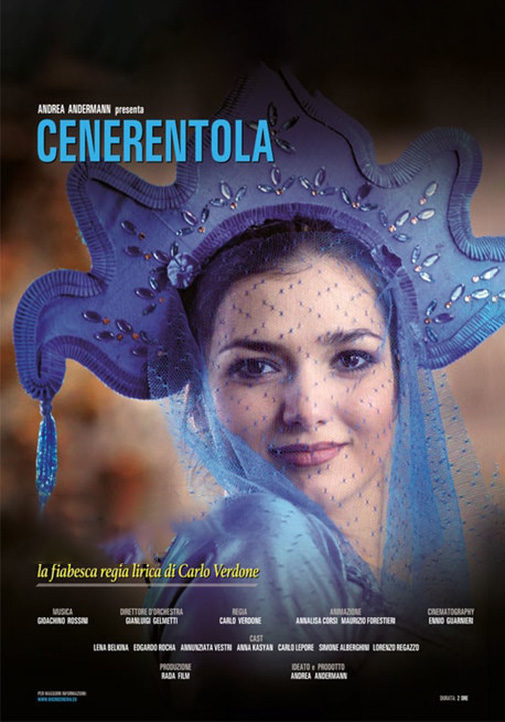
Cenerentola 2012
Carlo Verdone
A brilliant comedy that explores themes of justice, virtue, and identity, making universal the social and moral questions through a narrative that plays on deception, appearance, and redemption. The protagonist, a young woman relegated to the role of servant by her stepsisters and stepfather, dreams of escaping her misery and living a better life. Her encounter with a prince disguised as a servant, who seeks a bride who will love him for who he is and not for his status, opens the door to a series of disguises, identity swaps, and misunderstandings, which form the dynamic and comedic heart of the story. The protagonist's happiness is thus the result of her integrity, kindness, and ability to forgive, which ultimately lead her to justice and the recognition of her true worth.
The film version of Cenerentola, conceived and adapted by Andrea Andermann and directed by Carlo Verdone, reinterprets Rossini’s comic opera through a cinematic language that blends modernity and sophistication. Set in historical spaces that are treated as cinematic sets, the direction is distinguished by a skillful use of narrative fluidity and musical precision, creating a visually stimulating and richly ironic staging. In this version, the light and playful comedy that characterizes the libretto is elegantly rendered, using comedic timing in editing and the interaction between stage action and singing, to maintain the balance between the musical and dramatic dimensions.
The cinematic direction focuses on the liveliness of the characters and the intelligence of the protagonist, highlighting the comedic dynamics through careful direction that does not sacrifice the complexity of the original work. The historical setting, while remaining faithful to the context, becomes an element that fosters dialogue with the contemporary audience, thanks to attention to visual detail and the construction of spaces that evoke a real dimension while rich in symbolism. Cenerentola thus becomes an emblematic figure in the fight for social justice, where virtue and goodness are the only true measures of value, contrasting with the hypocrisy and appearances that mark the lives of the other characters.
The tone of the production, while maintaining the liveliness and energy of the comic opera, is enriched by an ironic lightness that, however, does not exclude a deeper reflection on social and moral dynamics. In this context, Andermann’s approach succeeds in skillfully balancing tradition and modernity, creating a work meant for a wide audience, yet without sacrificing the musical and narrative richness of Rossini’s original. Cenerentola thus becomes a fascinating reflection on virtue, sacrifice, and the value of authenticity in a world marked by masks and deception.
Director: Carlo Verdone (television director: Pierre Cavassilas). Story: Adaptation of Giacomo Ferretti's libretto for Gioacchino Rossini's opera, television adaptation by Andrea Andermann and Verdone. Music: Gioacchino Rossini; musical direction: Gianluigi Gelmetti with the RAI National Symphony Orchestra. Costumes: Tatiana Romanoff (costume designer), Cristiana Fabris (seamstress), Elisa Francescotti, Augusta Tibaldeschi (seamstress assistant). Cast: Lena Belkina (Cinderella), Simone Alberghini (Dandini), Anna Kasyan (Clorinda), Carlo Lepore (Don Magnifico), Lorenzo Regazzo (Alidoro), Edgardo Rocha (Don Ramiro), Annunziata Vestri (Tisbe).
Production: Rada Film (Rome) in association with RAI and with the support of the Film Commission Torino Piemonte. Distribution: Worldwide broadcast on Rai1 (live TV June 2012), theatrical version distributed by Microcinema in 2013. Origin: Italy. Year: 2012. Running time: 120 minutes.