
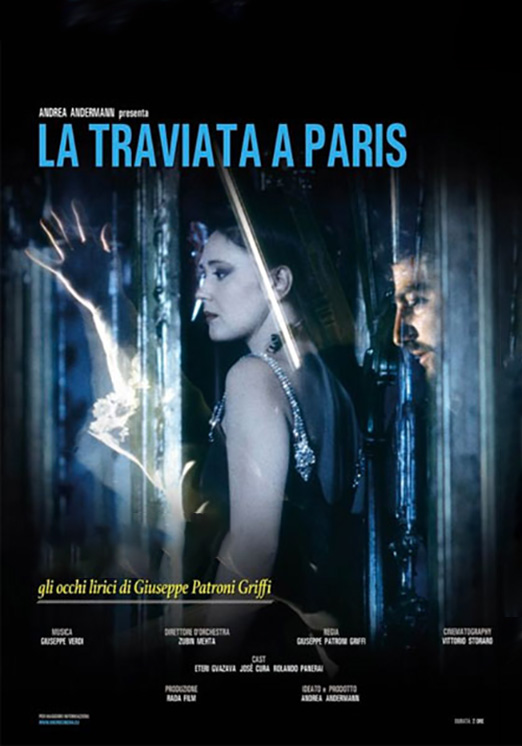
Traviata à Paris 2000
Giuseppe Patroni Griffi
Traviata is both a social and intimate drama that intertwines personal passions and class conflicts, shedding light on the struggle between love and rigid social conventions. Violetta Valéry, a courtesan symbolizing Parisian glamour and fleeting luxury, is at the heart of a work that addresses social inequalities, hypocrisy, and sacrifice. When the young woman falls in love with Alfredo Germont, a bourgeois youth, her life seems destined for a radical change. The two withdraw to the countryside, away from the conventions of Parisian society, to live their love freely. However, their dream of love is shattered by societal pressure and Alfredo’s father, who, concerned about his family’s reputation, asks Violetta to give him up. In an act of renunciation and sacrifice, Violetta agrees to separate from her beloved. When the truth finally emerges, it will be too late, and her decision will be inevitable. The tragedy culminates in Violetta’s death, symbolizing a society that condemns without understanding and cannot accept those who challenge its rules.
The direction, modern and incisive, emphasizes the intimacy of the protagonists, building a deep connection between the emotional dimension of the music and the visual one. The narrative unfolds over the course of a single day, heightening the urgency and spontaneity of feelings, as well as their transience. The use of close-ups and intimate shots creates an immersive experience, where the viewer is invited to live the characters’ emotions intensely and directly. The Parisian settings, from luxurious apartments to working-class neighborhoods, offer a visual contrast that mirrors the tension between appearance and reality, between fleeting beauty and the existential misery of the protagonists. Light and darkness, alternating in crucial scenes, become metaphors for the passage from illusion to disillusion, from love to death, amplifying the tragic dimension of the work.
In the context of cinematic direction, the visual and musical storytelling merge into a union that amplifies the opera’s pathos, breathing new life into Verdi’s melodrama. The protagonists’ suffering is reflected in a staging that, while faithful to the original text, enriches the sensory experience, transporting the audience into a more immediate and contemporary emotional experience. Violetta becomes the symbol of a society that refuses to accept fragility and individuality. Her solitary and tragic death stands as a final act of purity and self-determination, a catharsis that reflects the drama of the human condition and its struggle against social impositions. The choice to set the story in a modern Parisian context is not merely a scenic device but a reflection on the relevance of the themes, which still resonate today in social dynamics and the conflicts between individual freedom and social norms.
The film, through its fusion of visual and musical language, creates an intense emotional experience, where every gesture and every note seem to weave an invisible thread that connects the souls of the characters to those of the audience. The fate of the protagonists is revealed not only through their words but also through the images and sounds, making La Traviata not only a cinematic adaptation of an opera but also a profound reflection on the human condition. Sacrifice, unrequited love, and the abuse of power intertwine in a drama that transcends temporal boundaries, making the opera a powerful inquiry into the loneliness and disillusionment of those living on the margins of a society that cannot embrace their fragility.
Directed by: Giuseppe PatroniGriffi. Story and Screenplay: Conceived and written by PatroniGriffi and Andrea Andermann (television adaptation of Verdi's opera). Music: Giuseppe Verdi, conducted by Zubin Mehta, RAI National Symphony Orchestra. Production Design: Real locations in Paris (Italian Embassy, Palais, Île Saint Louis), urban contextual design. Cast: Eteri Gvazava (Violetta), José Cura (Alfredo), Rolando Panerai (Germont). Production: Andrea Andermann, in collaboration with RAI. Distribution: Worldwide broadcast by RAI (broadcast in approximately 125 countries), DVD release by 01 Distribution. Origin: Italy. Year: 2000. Running Time: 125 minutes.