
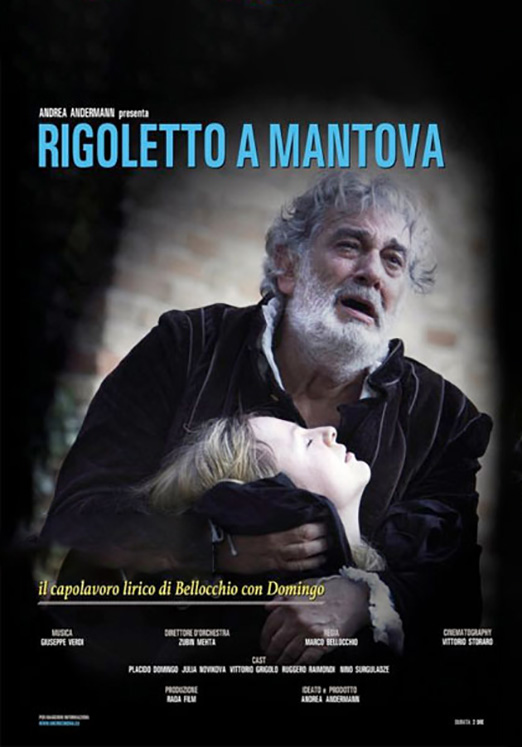
Rigoletto a Mantova 2010
Marco Bellocchio
Rigoletto is a Verdi opera that invites deep reflection on the nature of fate, revenge, and the contradictions of the human condition. The central figure, Rigoletto, a court jester in the service of the Duke of Mantua, embodies the eternal dichotomy between appearance and reality. Ridiculed for his role as a fool, he lives a life of public humiliation, yet conceals a paternal and protective heart for his daughter, Gilda, whom he keeps hidden from the world. His desire to shield her from the corruption of the court drives him to isolate himself, trying to preserve her innocence in a world that knows no mercy.
When the Duke, a libertine and manipulator, seduces Gilda, the balance of Rigoletto’s life is shattered. Blinded by rage and a thirst for revenge, Rigoletto devises a plan to punish him, but his scheme, instead of bringing justice, leads him to a tragic fate. The opera’s finale delivers a heart-wrenching twist, where the victim of the revenge plot turns out to be Gilda, the young daughter Rigoletto tried so hard to protect. The tragedy of Rigoletto is not only that of a father losing his only daughter but also the dramatic awareness of the inevitability of fate—of a revenge that becomes an act of self-destruction.
Andermann reinterprets Rigoletto in a visually and narratively powerful context, intertwining theater, cinema, and television. The historical locations, true to the places evoked in the libretto, are used to emphasize the solitude and existential condition of the characters, creating a visual contrast between wealth and the inner emptiness that pervades their lives. The direction employs shots rich in symbolic meaning, where angles and visual composition heighten the sense of emotional and physical imprisonment of the protagonists, suggesting the inexorability of their fate.
The decision to capture the action in real-time strengthens the sense of a continuous flow of tension and pathos, effectively portraying the contrast between the coldness of the court and the humanity of the characters. Rigoletto’s revenge, and his fatal deception, become the dramatic engine of the opera, propelling the characters toward a tragic outcome that seems predestined, as though the entire story were already written in the inevitable laws of fate.
This version of Rigoletto is an emotional journey that explores the nuances of justice and revenge, fatherhood and loss, but above all the difficulty of escaping a destiny that seems to govern every action. The vision of creator Andrea Andermann and the compelling direction of Marco Bellocchio bring the opera’s tragedy to life, leading to a universal reflection on the impossibility of escaping the forces that dominate us. The result is a theatrical and cinematic experience that confronts the audience with the ethical and moral themes of revenge, justice, and responsibility.
Director: Marco Bellocchio. Story and Screenplay: TV adaptation of Verdi's opera, libretto Piave / Victor Hugo (original opera) adapted for the film – concept by Andrea Andermann. Music: Giuseppe Verdi (conducted by Zubin Mehta, RAI National Symphony Orchestra), Solisti Cantori choir conducted by Emanuela Di Pietro. Costumes: Rosalia Guzzo, Margherita Maltese, Erminia Melato, Sonia Travaglia. Cast: Plácido Domingo (Rigoletto), Vittorio Grigolo (Duca), Ruggero Raimondi, Julia Novikova (Gilda). Production: Rai / concept by Andrea Andermann, worldwide television production in the “La via della musica” trilogy. Distribution: broadcast worldwide in 148 countries; live TV on RAI. Origin: Italy. Year: 2010. Running time: 130'